
Alphabet’s $94B SpaceX Bet: What the Post-IPO Drop Means
Explore Alphabet’s $94B SpaceX (SPCX) stake, the recent post-IPO stock fallout, and why Google is betting big on space infrastructure and AI compute.
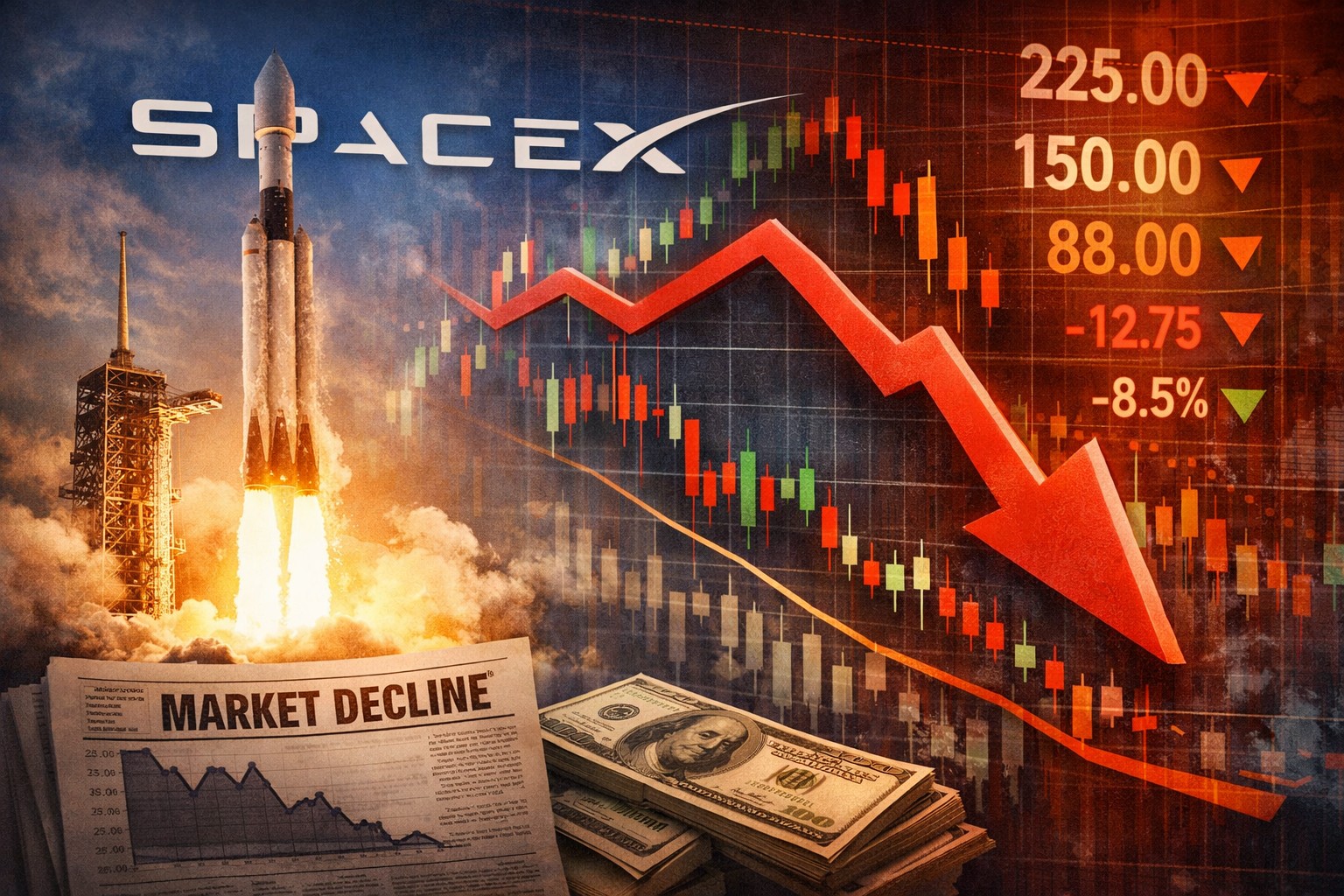
When Alphabet quietly disclosed a $94.1 billion stake in SpaceX (SPCX), the market barely had time to process the magnitude before the next headline hit: SpaceX’s newly public stock plunged more than 31% in a matter of days.
For most companies, a $29 billion paper loss would trigger panic.
For Alphabet, it triggered something more interesting — a rare look into how Big Tech is positioning itself for the next decade of AI, infrastructure, and geopolitical dominance.
This is not just another investment story. It’s a window into how Google (GOOGL) is wiring itself into the backbone of the world’s most ambitious aerospace and AI company — and what the recent IPO volatility really means for investors.
A Stake That Was Never Meant to Be Quiet
Alphabet’s position in SpaceX didn’t begin as a moonshot. It began as a $900 million investment in 2015, a strategic partnership designed to accelerate global internet coverage and strengthen Google’s infrastructure footprint. What no one expected was that the stake would compound into one of the largest private-company positions ever held by a public tech giant.
By June 2026, Alphabet owned roughly 550 million shares, representing about 4–6% of SpaceX depending on the valuation window. The position ballooned to $94.1 billion — a number Alphabet was required to disclose only after SpaceX’s IPO forced transparency.
But here’s the twist:
Most of Alphabet’s shares are locked up.
Roughly $80 billion worth cannot be sold in the short term, and another $14.1 billion is restricted until late 2027. Alphabet is not trading SPCX — it’s married to it.
The IPO Fallout: A $29 Billion Gut Punch
SpaceX’s IPO was one of the most anticipated market events of the decade. It debuted with explosive enthusiasm, surged, and then snapped back violently — dropping from $170.86 at the end of Q2 to $118.24 shortly after.
Alphabet’s stake fell from $94.1B to roughly $65B.
A $29 billion loss — “in the blink of an eye,” as one analyst put it.
But here’s the truth seasoned investors understand:
This wasn’t a failure. It was a cycle.
High-growth IPOs often experience early drawdowns before stabilizing.
Amazon, Tesla, Meta, Nvidia — all followed similar patterns. Alphabet knows this. SpaceX knows this. The market, eventually, remembers this.
Why Alphabet Isn’t Worried — And Why Investors Should Pay Attention
Alphabet’s relationship with SpaceX is no longer just financial. It’s infrastructural.
SpaceX Is Now an AI Compute Provider
In June 2026, Alphabet signed a multi-year, ~$30 billion AI compute agreement with SpaceX, paying roughly $920 million per month for access to 110,000+ Nvidia GPUs housed in SpaceX’s hardened, distributed infrastructure.
This is one of the largest AI compute contracts ever disclosed.
Alphabet isn’t just investing in SpaceX.
Alphabet is running on SpaceX.
Starlink + Google Cloud = Global Infrastructure
Since 2021, Google Cloud has hosted Starlink ground stations at its data centers. This gives Alphabet something no other cloud provider has:
- Global low-latency coverage
- Redundancy across orbital networks
- A strategic hedge against terrestrial outages
SpaceX is becoming part of Alphabet’s backbone.
SPCX Volatility Doesn’t Change the Strategic Value
Alphabet’s stake is illiquid by design.
It’s not a trading position — it’s a strategic anchor.
The IPO drop doesn’t change:
- Alphabet’s access to SpaceX infrastructure
- Alphabet’s role in Starlink’s global expansion
- Alphabet’s AI compute pipeline
- Alphabet’s long-term exposure to the world’s most ambitious aerospace company
If anything, the volatility reinforces why Alphabet wanted the stake early — before SpaceX became the most geopolitically important company in the world.
Tesla’s Position: A Smaller but Symbolic Stake
Tesla also disclosed a SpaceX position — roughly 19 million shares, less than 1% ownership. The stake originated from Tesla’s investment in xAI, which SpaceX later absorbed.
Tesla’s exposure is small compared to Alphabet’s, but symbolically important:
Two of the Mag‑7 now hold equity in SPCX.
Alphabet’s stake is strategic.
Tesla’s stake is ecosystem-driven.
Both matter.
What the IPO Fallout Really Means
SpaceX’s early volatility is not a referendum on its future. It’s a reflection of:
- Massive retail enthusiasm
- Institutional recalibration
- The natural cooling phase after a historic IPO
The challenge of valuing a company that spans aerospace, defense, AI, and global communications
Alphabet’s $94B position is not a gamble — it’s a blueprint.
SpaceX is becoming:
- A global ISP
- A defense contractor
- An AI compute provider
- A satellite manufacturer
- A launch monopoly
- A data infrastructure partner
Alphabet is positioning itself at the center of that universe.
The Private Equity Lion View
Alphabet’s $94B SPCX stake is one of the most strategically important positions held by any public company today. The IPO fallout is noise — violent, dramatic, headline-grabbing noise — but noise nonetheless.
The signal is this:
Alphabet is aligning itself with the company most likely to define the next 20 years of global infrastructure.
SpaceX is no longer just rockets.
It’s compute.
It’s communications.
It’s defense.
It’s AI.
It’s the backbone of the next technological era.
Alphabet didn’t lose $29 billion.
Alphabet bought time — and proximity — to the future.



Leave a Reply