
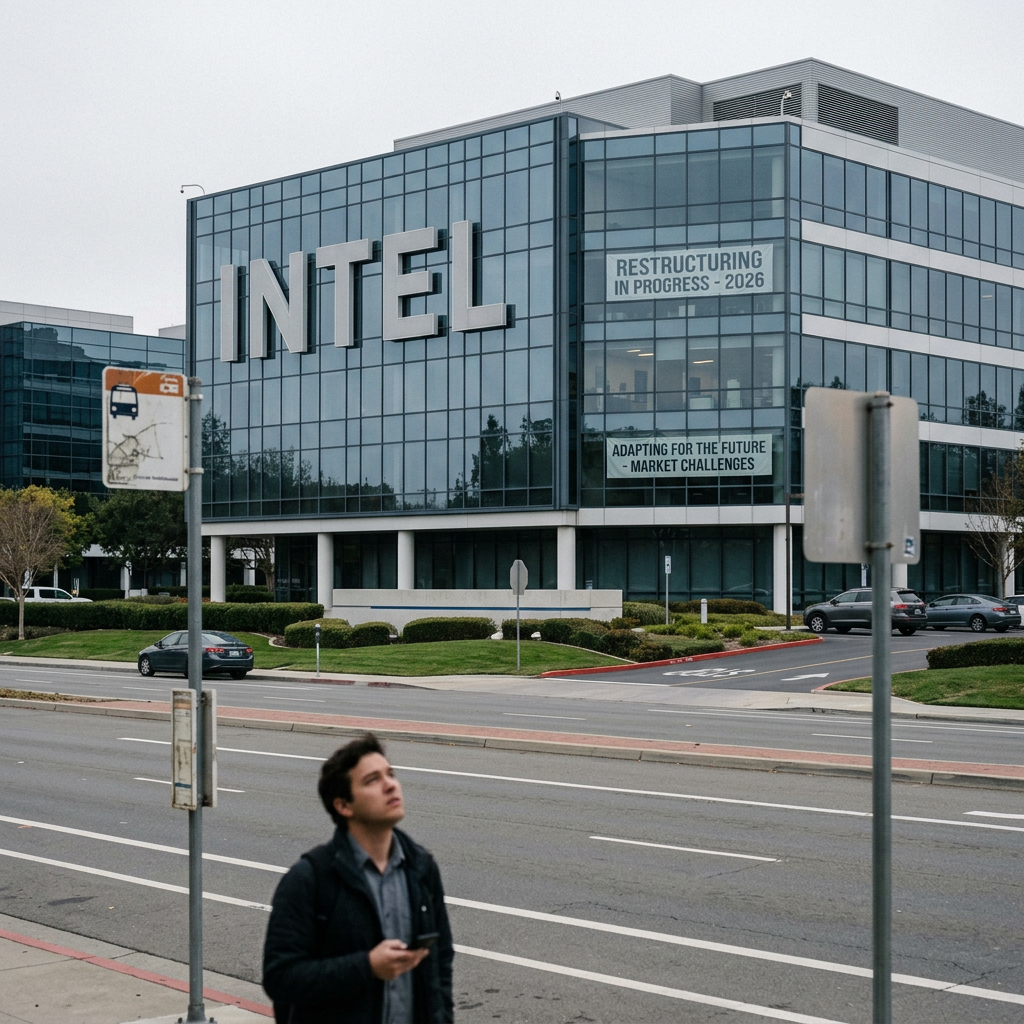
Intel’s retreat in late 2026 didn’t happen overnight.
It’s the kind of slowdown you notice the way you notice a familiar engine losing its hum—subtle at first, then impossible to ignore.
Investors who once saw Intel as a steady anchor are now watching a company struggling to keep pace in a market that’s moving faster than ever.
The question isn’t just why Intel is slipping, but what this retreat says about the future of chipmakers competing in a world reshaped by AI, new architectures, and relentless innovation.
Key insight about INTC: Potential TSMC participation in Terafab and accelerating AMD CPU share gains threaten Intel’s strategic position. At the same time, sharply wider GAAP losses and mixed analyst ratings are countered by revenue growth and positive insider buying, sustaining high uncertainty around execution and valuation.
Recommendation: Hold
Price Targets: $109–$124 (most likely range in next 6 months)
Unconfirmed TSMC talks threaten Intel’s Terafab role.
Recent reports of Tesla discussing TSMC’s participation in the Terafab project alongside Intel introduced uncertainty about Intel’s role and contributed to a near-term pullback in INTC shares despite a strong prior-year rally.
- Tesla was reported in talks with TSMC about joining the Terafab operation, a development viewed as a significant setback that could reduce Intel from a leading producer to a secondary participant.
- Yahoo Finance noted that adding TSMC would shrink Intel’s role in Terafab and challenge a valuation that assumes continued foundry wins and sustained contract visibility.
- Elon Musk stated the matter involves discussions that may or may not lead to an agreement, leaving Intel exposed to downside risk if TSMC is included while near-term price pressure reflected investor concern.
Rapid AMD gains erode Intel’s CPU foundation.
A Tom’s Hardware report based on Steam Survey data and recent Wall Street ratings indicates intensifying competitive pressure in Intel’s core CPU business alongside a broadly neutral analyst consensus and modest expected downside.
- Tom’s Hardware cited Steam Survey results showing AMD holding 48.4% of the CPU market after rising from just under 45% in May, a rapid gain that suggests AMD is closing the gap with Intel despite survey error margins.
- Erosion of Intel’s long-standing CPU leadership represents a major strategic risk because Intel previously offset GPU losses by defending CPUs, and renewed CPU share losses would materially weaken its competitive position.
- Wall Street analysts assigned a Hold consensus on INTC over the past three months with six Buys, twenty-two Holds, and two Sells, and the average price target of $114.38 implies approximately 2.19% downside risk.
Conflicting analyst calls and insider buying meet red ink.
Recent analyst commentary showed mixed stances around Intel while quarterly revenue growth coincided with a sharply wider GAAP loss and positive insider buying signaled management confidence.
- Mizuho Securities analyst Vijay Rakesh, a top 25 TipRanks analyst with a 73.5% average return and 68.92% success rate covering Intel and other technology stocks, reiterated a Hold rating on Intel yesterday with a $114.00 price target.
- Additional recent actions included TD Cowen’s Joshua Buchalter reiterating a Hold on September 23 and Bank of America Securities reiterating a Buy on Intel on September 25.
- Quarter ended June 27 revenue $16.13B versus $12.86B and GAAP loss $11.03B versus $2.92B as 27 insiders increased purchases.
Intel’s retreat in 2026 is more than a headline.
It’s a reminder that even the biggest names can lose their footing when the ground shifts beneath them. The company isn’t disappearing, but it is being forced to rethink what it means to compete in a market where speed, innovation, and adaptability decide the winners. For investors, this moment is a chance to step back and see the broader landscape: a chip industry in transition, new leaders rising, and old giants trying to find their next move. Intel’s story isn’t finished, but the chapter we’re watching now is one that will shape how the entire sector evolves from here.


Leave a Reply